Our age in a nutshell: externality-denying capitalism is now spawning reality-denying business models.
In October, Mark Zuckerberg announced the rebranding of Facebook as ‘Meta’, short for ‘metaverse’. Based in virtual and augmented reality, the metaverse (‘beyond the Universe’) will provide a whole new space for human beings to meet, attend concerts and even try on clothes. It has been brilliantly lampooned by the rival offering of Icelandverse.
The announcement of Meta provides just the latest hint that externality-denying capitalism is detaching from reality, and dragging ‘common sense’ with it.
Karl Polanyi warned of exactly this in 1944, with his thesis that markets would slowly ‘disembed’ from social and ecological reality unless they were continually re-grounded by extra-market input. The market system, compellingly logical and ‘complete’ to the producers, consumers and investors acting within, would cultivate a collective decision-making that would progressively favour market signals over non-market signals, to the eventual neglect and erosion of its own social and ecological foundations. Virtual business models – epitomizing a virtual capitalism – would seem to be a near-terminal phase. As Bob Collie has succinctly expressed it, a virtual, or externality-denying, capitalism effectively eats itself.
More recently, Iain McGilchrist has warned that the same pattern appears in our human brains in which the ‘newer’, more abstracting left brain emerges out of the ‘older’ more grounded right brain, only to then deny the dependency.
Behavioural guidance systems – whether left brains or left brain-inspired market systems – that detach from reality risk entering into a self-destructive runaway spiral of eroding their own foundations.
Alas, the pattern describes our whole approach to the climate and biodiversity crisis. We are seeking to solve real, biophysical problems with a disembedded market logic that solutions must be profitable, denying that it is precisely the pursuit of disembedded, reality-denying, profit that is creating the problem.
We are becoming dangerously meta-foolish without recognizing.
Or perhaps not all of us. A big economy that was pivoting away from virtual business models might be gaining an advantage over those economies content to drift into a make-believe world.
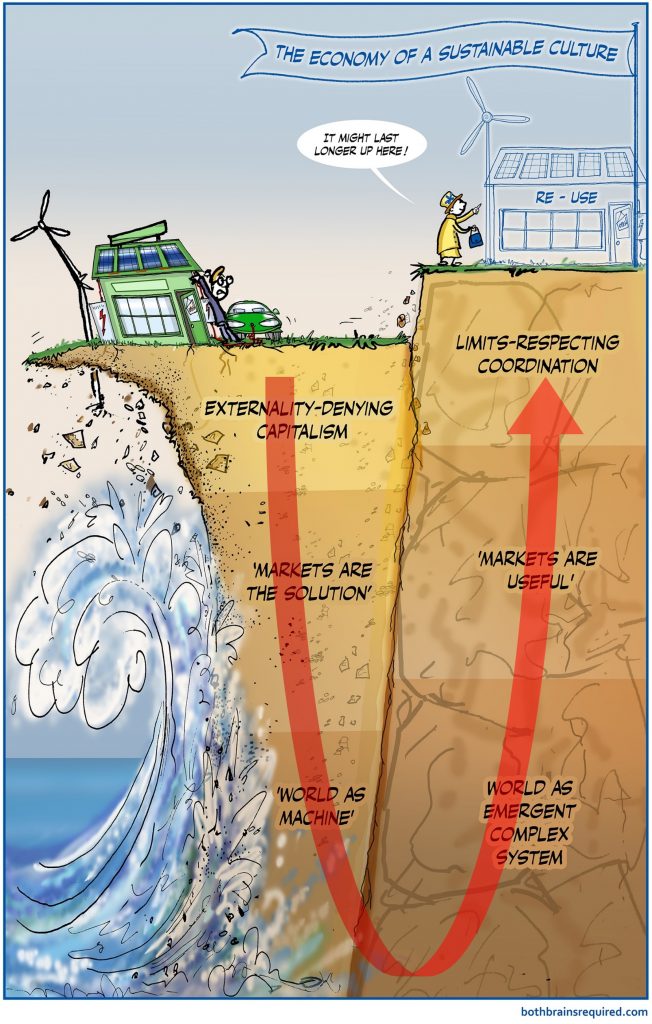
What to do? Re-grounding would seem to be order of the day. Digging back down through the disembedded decision-making structures we have unwittingly developed, to reattach our perception of the world and our values to biophysical reality, before building up again – crudely, working down the left-hand side of this picture and then back up the right-hand side.
Leave a Reply